Issue № 2 · Story II
The Red Boots
Five names in ballpoint down a left boot shaft, three dollars a chapter. Lena Fisk came to the Saturday market to give things away, not to find them.
The stall had a hand-painted sign that said EVERYTHING HERE WAS SOMEBODY’S, and under the sign, toes out, third table from the end, sat her brother’s boots.
Lena Fisk had come to the Saturday market to give things away, not to find them. Her mother’s house was sold, and the boxes in her trunk were the last of it, mixing bowls and a lifetime of pie tins, all bound for Opal Rance’s stall because that’s where things in this town went when their people were done with them. She was not in the market for any more.
Then the red.
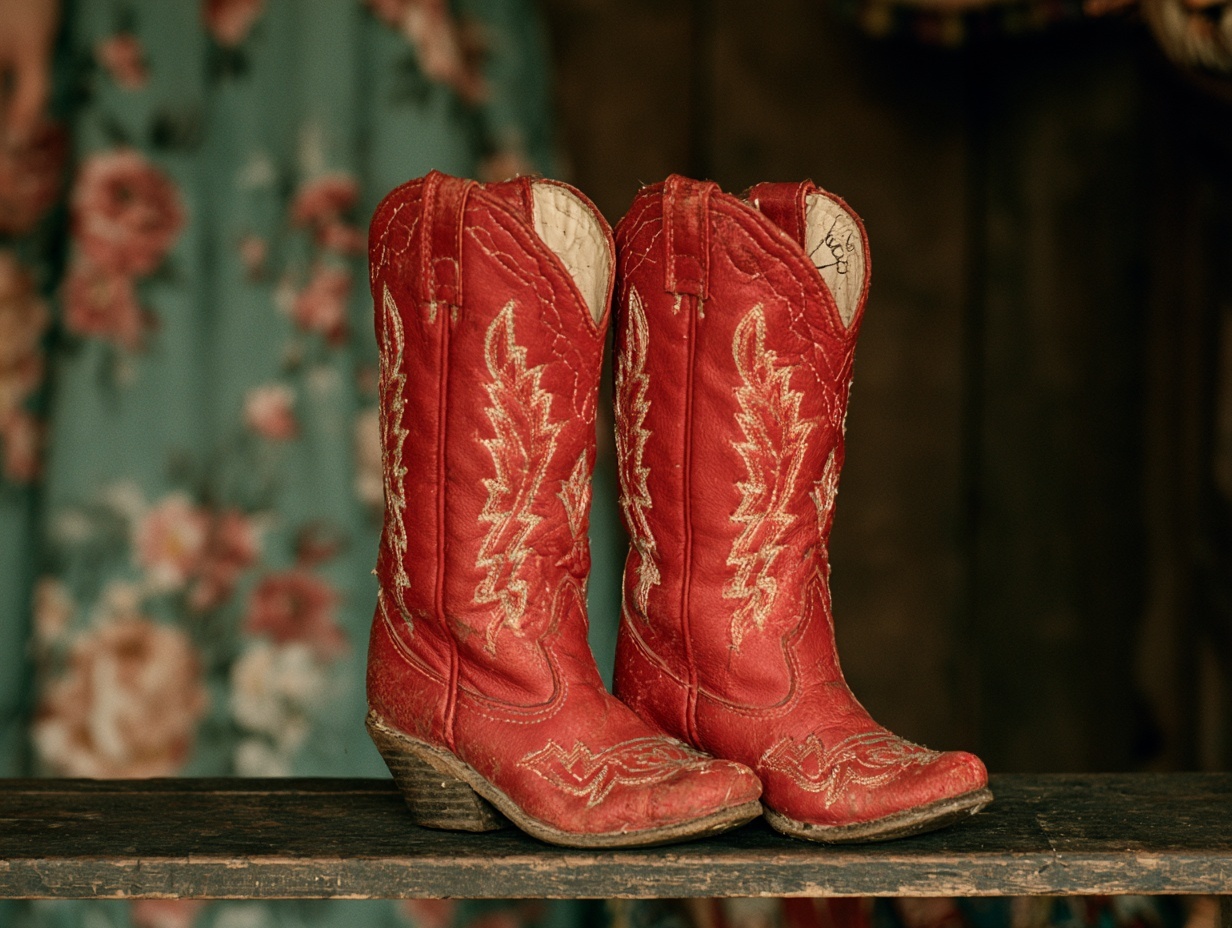
You could have shown her ten thousand pairs of red kids’ cowboy boots and she’d have known these at thirty feet. The heels were worn on the outside edges, because Davy had walked on the outsides of his feet his whole short life, listing a little, like a boy leaning into weather nobody else could feel. The left pull strap was chewed soft. The stitching up the shafts made little lightning bolts. Toes out, the way Opal always displayed them, so they looked less like merchandise and more like a horse waiting at a fence.
She picked them up the way you pick up a sleeping animal. Inside the left shaft, in ballpoint gone brown, five names rode one above the other in five different children’s hands.
The second name was Davy Fisk, with the backwards y he never once got right.
She stood there holding her dead brother’s handwriting in a crowd of strangers buying waffle irons, and the market went on around her, smelling of kettle corn and rain on canvas, and it was a long moment before she could read the other four.
“Three dollars,” Opal said from her folding chair, not looking up from her crossword.
“Opal. You know whose these were.”
“I know whose they were five times.” Opal set the puzzle down. She was somewhere north of eighty and had run the stall since before Lena was born, and she had a face like a walnut and a memory like a courthouse. “You want the whole title history, or just his chapter?”
The boots kept their own record, but Opal kept the rest.
They’d come to her in 1984 in a box lot from the Aldous ranch auction, hardly worn, still smelling of the store. For two years they sat toes out while wrong kids reached for them and Opal said, without ever explaining herself, that they were spoken for.
The first name was Pol Greer, 1986. Pol was the new girl that year, from downstate, with a stutter that got her laughed at by September. She wore the boots every day of third grade like armor you could buy for pocket money. She’s the one who chewed the pull strap. She’s also a doctor in Billings now, and every few years a Christmas card comes to the stall, addressed only to Opal, boot lady, and the post office knows.
Pol brought them back when her toes folded. That was the deal, though nobody ever wrote it down. Three dollars bought you the boots for as long as they fit, and when they didn’t, they came home to the table. Ownership at Opal’s stall was less like buying and more like borrowing from everyone at once.
Davy got them in 1991, the autumn their father left.
Lena was fourteen that year and mostly remembers the quiet, how the house got so careful, everyone walking like the floor was somebody sleeping. Davy was seven, and he stopped talking at school, and some committee of adults sent home worried notes on colored paper. Then one Saturday their mother gave him three dollars at the market for no reason anyone stated, and he came back wearing red boots, and he wore them the way other kids wear a cast, like proof that something had happened to him and he was still walking.
He galloped everywhere for two years. He wore the heels down on the outside edges leaning into his invisible weather. He slept in them the first week, and their mother let him, which told Lena more about that year than anything anyone said out loud. When he finally outgrew them he cried once, privately, that she knows of, and then he marched them back to the stall himself, and signed the shaft with the backwards y, and said the thing Opal has been quoting for thirty years.
He died the winter he was eleven. It had nothing to do with bravery or boots, and Lena has spent her whole adult life failing to make that matter. Grief doesn’t audit causes. It just takes the till.
The third name was two names, Russ and Ray Vail, 1996, because the twins bought them together with pooled lawn money and worked out a custody schedule that broke down inside a month. For a while each twin wore one red boot and one sneaker, which the town found either charming or a sign of poor parenting, depending on the porch you heard it from. It was the Vail era that split the left seam, and their grandfather sewed it shut with fishing line, ugly and permanent, and Opal will tell you that repair is her favorite thing on the whole table. The twins’ scared season was their parents’ divorce, which was loud where the Fisks’ had been quiet, and the boots did the same work either way.
Marisol Cano signed fourth, 2005. Her family was new that year, new to the town and the country both, and she had almost no English yet and a watchfulness that Opal recognized on sight. The wrong kids reached for the boots twice that spring. Spoken for, Opal said, twice. Then Marisol drifted up to the table, and the boots were suddenly out, toes forward, three dollars. Marisol’s the one who touched up the scuffed left toe with her mother’s nail polish, a red that doesn’t quite match and catches the light different, and when she brought them back she’d grown four inches and could argue in two languages, and the note she left in the toe said, in careful block letters, FOR THE NEXT ONE.
The fifth name came back only last month. Tucker Bealle, whose mother spent last year in and out of the hospital up in Ferris, and who wore the boots to every visit like a uniform, and who left a ghost on the right shaft where a glitter sticker lived and died. Tucker’s mother is home now. Tucker’s feet are two sizes past done.
“So they’re for sale,” Lena said.
“They’re always for sale,” Opal said. “To the right customer.”
Lena looked at the five names again. Reading down the shaft was like reading the rings of a tree, if a tree kept its rings on the inside where you had to be holding it to know. “You never once sold these to a happy kid,” she said slowly. “Forty years. Every name on here was having the worst year of their life.”
“That’s right.”
“That’s not luck.”
“No, it is not.” Opal folded her hands. “Your brother started it. When he brought them back, he stood right where you’re standing, nine years old, serious as a deed, and told me, give them to somebody scared. So that’s the inventory system. I just kept his store.”
Lena had to look at the waffle irons for a while.
She paid the three dollars. Opal took it without comment, because Opal understood the difference between a sale and a visit, and made change for a five like it was 1984, and did not say anything about bringing them back.
The boots rode home on the passenger seat.
That night in the emptied house Lena sat on the floor of what had been Davy’s room and held them and let herself have it, the whole night of it, the kettle-corn smell still in the leather under the dust, the fishing-line scar, the wrong-red toe, his backwards y. She thought about the shelf in her apartment where they could live from now on, safe, dusted, retired, and about the small museums people make of the people they lose, and she understood the choice with a clarity that felt less like thinking and more like being told.
On a shelf they’d be a headstone. On a kid they were still a verb.
She had no right to end a sentence Davy started.
Sunday she drove past the market grounds, empty, canvas gone. She kept the boots one more week. She oiled the leather with the kit from her trunk, and she did not touch the repairs or the polish or the strap, because you don’t clean provenance off a thing, you only feed the leather that carries it. And she wrote a note of her own on a square of paper, folded small, and slid it into the right toe where Marisol’s had ridden, which is the other place history keeps, and what it said is between her and whoever finds it.
Saturday came back around the way Saturdays do.
She set the boots on the third table, toes out. Opal watched her do it and pushed the three dollars back across the table, and Lena pushed it back again, and they left it there between them, which is how women of a certain temperament hug.
“You could sign the shaft,” Opal said. “There’s room.”
“I never wore them.” Lena shook her head. “I’m not an owner. I’m just,” and she looked for the word and found it where Davy left it, “management.”
They sat together most of the morning, the crossword between them, the market doing its slow Saturday breathing. Wrong kids reached for the boots twice. Spoken for, said Opal, twice, and the wrong kids shrugged and bought other people’s yo-yos and other people’s baseball mitts, because everything there was somebody’s, that was the whole point of the place.
The girl came at eleven. Maybe eight years old, hanging back at the table’s corner the way you hang back when wanting things has been going badly lately. New sneakers, too white, the kind bought for a school she hadn’t started yet. She had moving-boxes posture. She had the watchfulness. She looked at the red boots the way Davy had looked at them across thirty-five years, like a horse at a fence, saddled, waiting, hers if she could just be the kind of person who believed it.
Lena felt Opal go still beside her, felt the old woman deciding, and then felt her decide.
“Those are spoken for,” Opal said, and the girl’s face began the fall it had clearly been practicing all summer. “By you, if you want them. Three dollars.”
The girl looked at her grandmother, who was already digging in her purse with the particular urgency of a woman who has watched a child stop asking for things. The bills came across the table old and soft. The girl sat down right there in the aisle grass to pull the boots on, left first, and they fit the way they had fit every one of them, which was almost, which was room to grow.
She galloped. Of course she galloped. Down the aisle past the waffle irons and the pie tins that had been Lena’s mother’s, red boots flashing under the canvas light, leaning into weather nobody else could feel yet.
Lena watched until the crowd took her, this small stranger walking around inside the bravest thing her family ever owned, and it did not feel like watching something leave. It felt like watching it keep going. Somewhere in town, from now on, there would be a kid being brave in her brother’s boots, and when this one brought them back, sixth name on the shaft, front toe holding a folded square of paper, the store that Davy started would still be open.
Three dollars. Same as it ever was. Opal did not believe in doing arithmetic on children.
♥ 2026 Claire Jacobs · CC BY 4.0 · a story from Good Day Mockingbird № 2