Issue № 2 · Story III
How Long Will You Be
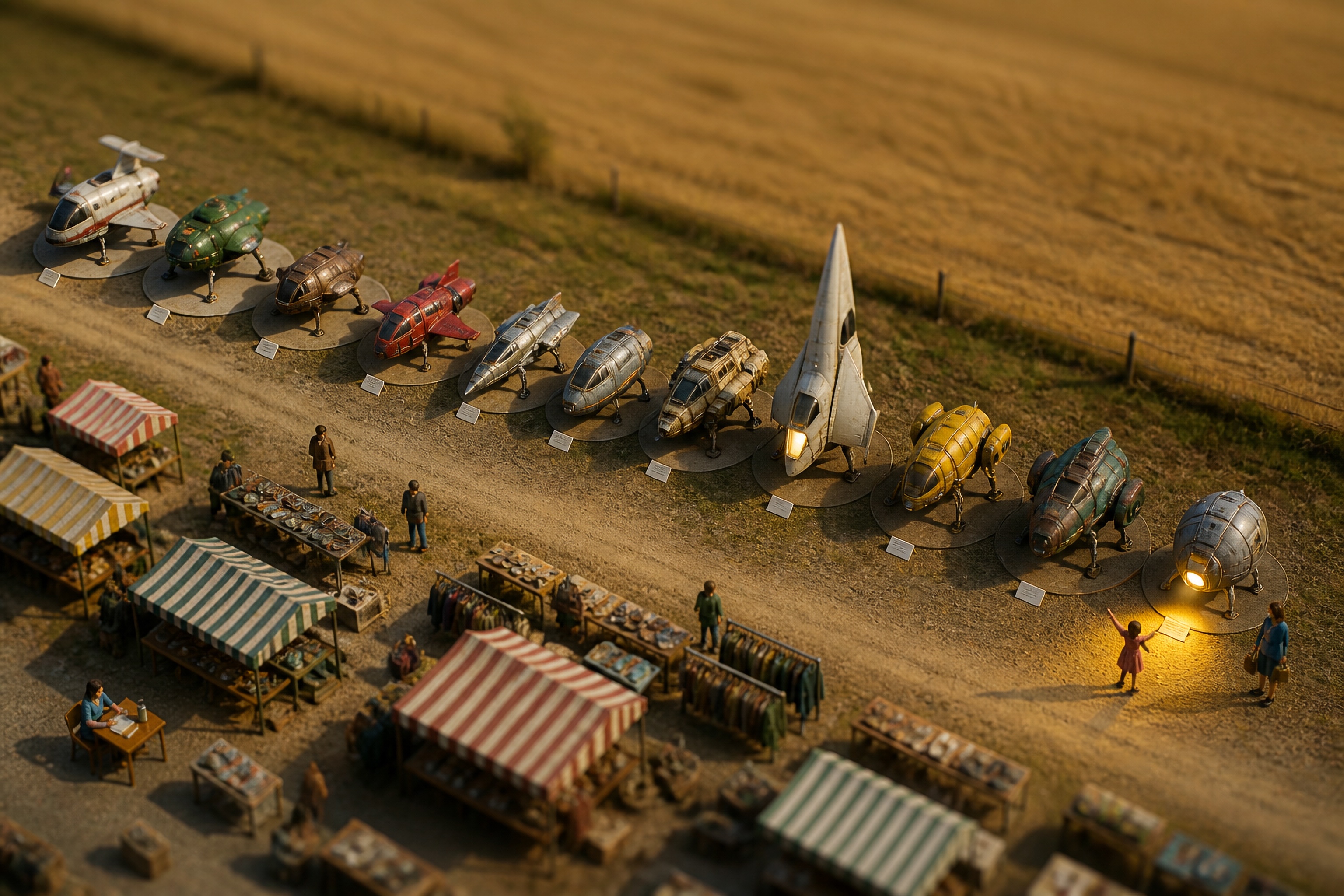
Eleven little ships on their pads at the far end of the market, past the crockery and the coats. The small gray one turns its light to follow you, and it only wants to know one thing.
The ships were at the far end, past the crockery and the coats, and Nell would have missed them if one hadn’t lit up as she went by.
Nell and her mother had been an hour in the market already, and Nell had been good about it, which was the deal. There were eleven ships in a row, on their landing pads, each with a price card propped up on the pad in the same square handwriting. The woman who owned the stall sat at a folding table back where the stalls left off, with a flask and a folder and a paperback face-down on her knee, and she looked up when Nell stopped. Then she looked back down, which Nell took to mean she could stay.
“We’re getting a practical one,” her mother said behind her. “We are not getting a silly one.”
“I know.”
Most of them did something when you came close. A green one flashed its lights in a pattern that was probably meant to be a greeting and looked more like an argument. A tall white one that had clearly been polished that morning said, in a warm and confident voice, that it had been very well looked after and had never once been late, and the woman said “That’s enough” without lifting her eyes from the page. “Not that one either,” Nell’s mother said, to nobody in particular. One played the first bar of a tune and stopped. Nell walked the row slowly, the way you do when you’re allowed to look and not allowed to ask yet, and it was on her way back that she noticed the gray one’s light.
It was the smallest of them, or nearly, and it had once been white. Its light was on, the way all of theirs were, but when Nell moved, its light moved — swung a little on its mount to keep her in it, the way a dog tied up outside a shop turns its head to keep you in view. She stopped, and it stopped. She stepped left, and it followed.
“That’s Tuesday,” the woman said, without looking up. “It’s not doing anything. It just does that.”
“Why’s it called Tuesday?”
“Came in on a Tuesday.”
Nell crouched. Up close the gray was chalky and even, and there was a seam along its side that had been resealed at some point with a slightly different gray, and a strut that was newer than the other three. She put her palm flat on its nose. The paint was warm from the sun.
“Hello,” she said.
“How long will you be?”
It had a small, clear voice that came from a grille under the front window, and it asked the question politely and quickly, the way you’d ask what time it was.
“I’m right here.”
“Yes. How long will you be?”
Nell looked round at the woman, who had put her thumb in her book to hold the place.
“It asks everyone that,” the woman said. “It’ll ask you when you leave and it’ll tell you when you come back. To the minute. It’s not being clever, it’s not being sad, it just keeps count.” She got up, then, and came down the row, and stood by the pad with her hands in her cardigan pockets, and Nell understood that this was the one the woman had wanted somebody to stop at.
“Ask it how long the last one was.”
“How long was the last one?”
“Two years, seven months, and one day,” said the ship.
Nell’s mother had come up behind her. Nobody said anything for a moment.
“He wasn’t unkind,” the woman said. “I’ll say that. He was away a lot, on long terms — the kind you don’t come home from at weekends — and he’d come and leave it here — not here, but a place like this — and go, and he never once said how long. Weeks. Months. That last time, two years and change. And then he’d turn up, and off they’d go, and it was as if he’d been gone an afternoon.” She looked at the ship rather than at them. “The thing is, he always did come back. Every time. So it never learned that people don’t, and it never learned that people say when. It just waits, and keeps count, and asks.”
“That’s not so bad,” Nell said.
“It’s not bad at all. It runs its light all night, though, in case. I’ve stopped fighting it about that. And it will tell you, when you get back from wherever, exactly how long you were, and it won’t mean anything by it, and you’ll feel like you’ve been told off anyway. That’s the worst of it. And that’s not that bad.”
Nell sat back on her heels. The light stayed on her.
“Can I look at the others?” she said, to her mother, and her mother said she could, and as she stood up the ship said, “How long will you be?”
She thought about it. “Two minutes.”
She went and looked at the tall white one, mostly because it was the one she’d been told not to want. It told her again that it had never been late, and it showed her its lights, and it was clean the way a thing is clean when it has been made clean rather than kept that way. She looked at the green one, which argued at her, and at a small brown one that had gone to sleep and would not wake up. She was counting in her head the whole time, the way you count when you’re hiding, and when she got to a hundred and ten she turned round and walked back and stopped in front of the gray one and crouched down again where she’d been.
“One minute and fifty seconds,” it said.
“I said two.”
“You said two.”
Its light had come back to her as she walked up, and stayed. She waited for it to say something else, but it didn’t; it had reported the number, which was what it did, and now it was just looking at her.
“People say two,” it said eventually.
“I know they do.” She put her hand back on its nose, where it had been warm before and was warmer now. “I’m going to talk to my mum now. I’m not going anywhere, though.”
“Not anywhere,” it said, as if writing it down.
Behind her, her mother had gone quiet in the particular way she went quiet when she’d decided something and was going to take a while to admit it. The woman had gone back to the table and was uncapping the flask, and was not watching them at all, quite carefully.
“It’s going to ask you every single time you go to the loo,” her mother said.
“So I’ll tell it.”
“You’ll tell it.”
“You just tell it. And then you come back when you said.” She said it as if this were the most obvious thing in the world, which to her it was, and her mother looked at her, and then at the ship, and then at the price card, and did the face she did at prices.
“Where would we even keep it?”
“Where we kept the old one.”
Her mother didn’t answer that, and Nell hadn’t really expected her to.
“It’s bigger than the old one,” Nell said, more carefully.
“Everything’s bigger than the old one.”
The woman came back down the row with the folder, and opened it on the pad, and there were its papers: three sheets, the top one much handled. Her mother read them the way she read letters from the school, standing, one hand on her hip.
“Built for the survey,” she said. “Thirty-one years with the survey.”
“They kept it well,” the woman said. “You can see that. Then a family — eleven years, that’s where the seam’s from, and the strut, and it’s had four kids’ names painted on it under there if you look. Then him, nine years. Then me.”
“It’s older than I am.”
“They last.” The woman turned the top sheet over so the mother could see the back of it, where the names of the previous owners were listed in a column in different inks, each with a date and a signature beside it where one owner had handed it to the next. His was the only name with nothing beside it. Nell’s mother looked up from the sheet at the woman, and the woman looked back at her, and the ship’s light lay on Nell the whole time, and neither of them said anything at all. “That’s the point of them. Nobody buys them new. Not families.”
Her mother stood there for a while longer than the sheet needed. “We’d be walking home at that price,” she said, and the woman said, “You’d be flying home,” and her mother was quiet a moment and then laughed, once, the first laugh Nell had heard out of her all day. She got her wallet out and counted it onto the folder, all of it, note by note, and the woman wrote a receipt in a book with a carbon under it, and tore it out, and gave it to Nell rather than to her mother, and Nell folded it once and put it in her pocket.
“You’ll want to say goodbye to it,” her mother said to the woman, and the woman said, “No, I won’t,” and went and sat down and picked up her book.
She didn’t wrap it. Nell had half thought there’d be something — a box, a bag, a bit of paper — but the woman just said, “It knows the way to the gate. Go on, Tuesday,” and the ship lifted off its pad, and Nell and her mother walked back up the row past the coats and the crockery, and it came along behind them at walking pace, low, its light on Nell’s back the whole way. Past the last stall the ground stopped being stalls and started being just ground, and the sky came all the way down to it.
The ship went past them then, and turned, and settled, and let its side down.
Her mother went up the ramp first, bending her head under the top of the door.
Nell went after her. Inside it was cool and dim, and there was the seat where you sit and the other seat, and her mother sat down in the first one and put her hands where your hands go, and Nell got up into the other one, which was too big for her, and she liked that. Through the front window she could see all the way back down the row they’d walked: the ships in a line on their pads with their white cards, the shiny ones and the dull ones, the green one still arguing with nobody, and back among the stalls the woman at her folding table, already pouring from the flask, no bigger than Nell’s thumb.
“How long?” her mother said, in the voice she used for asking things of machines.
“Nine hours and forty minutes,” said the ship — the same voice, but from all round them now instead of from a grille. And then, after a moment, in exactly the way it had asked everything else: “Will you be aboard? The whole way?”
“Where else would we be?” her mother asked.
The ship did not answer that. Its light — Nell could see the glow of it on the ground ahead — swung once, left and then right, and came back to centre, and the ground began to drop away.
“Nine hours and thirty-nine minutes,” it said.
“You can stop that,” her mother said.
“Let it,” Nell said.
Her mother looked at her, and then didn’t say anything, and after a bit she reached over and pulled the belt across Nell and clicked it, and settled back in her own seat, and the row and the field and the woman went small behind them and then went altogether.
“Nine hours and thirty-eight minutes,” said the ship, to the two of them inside it, and kept on, quietly, and Nell was asleep before the hours got to eight.
♥ 2026 Pete Kaminski · CC BY 4.0 · a story from Good Day Mockingbird № 2