Issue № 10 · Story III
Destur
A covered market, a han of four floors with no two stairs cut the same, and a porter who has walked under the word destur, make way, for thirty-nine years and owns nothing in the bazaar but his saddle. Then a freight elevator arrives in nine crates, the guild votes ninety to nothing not to touch them, and Rüstem does the arithmetic on his ceiling. The stairs take a man one step at a time, starting at the knees, and his sister’s boy is nineteen and already stiff on wet mornings.
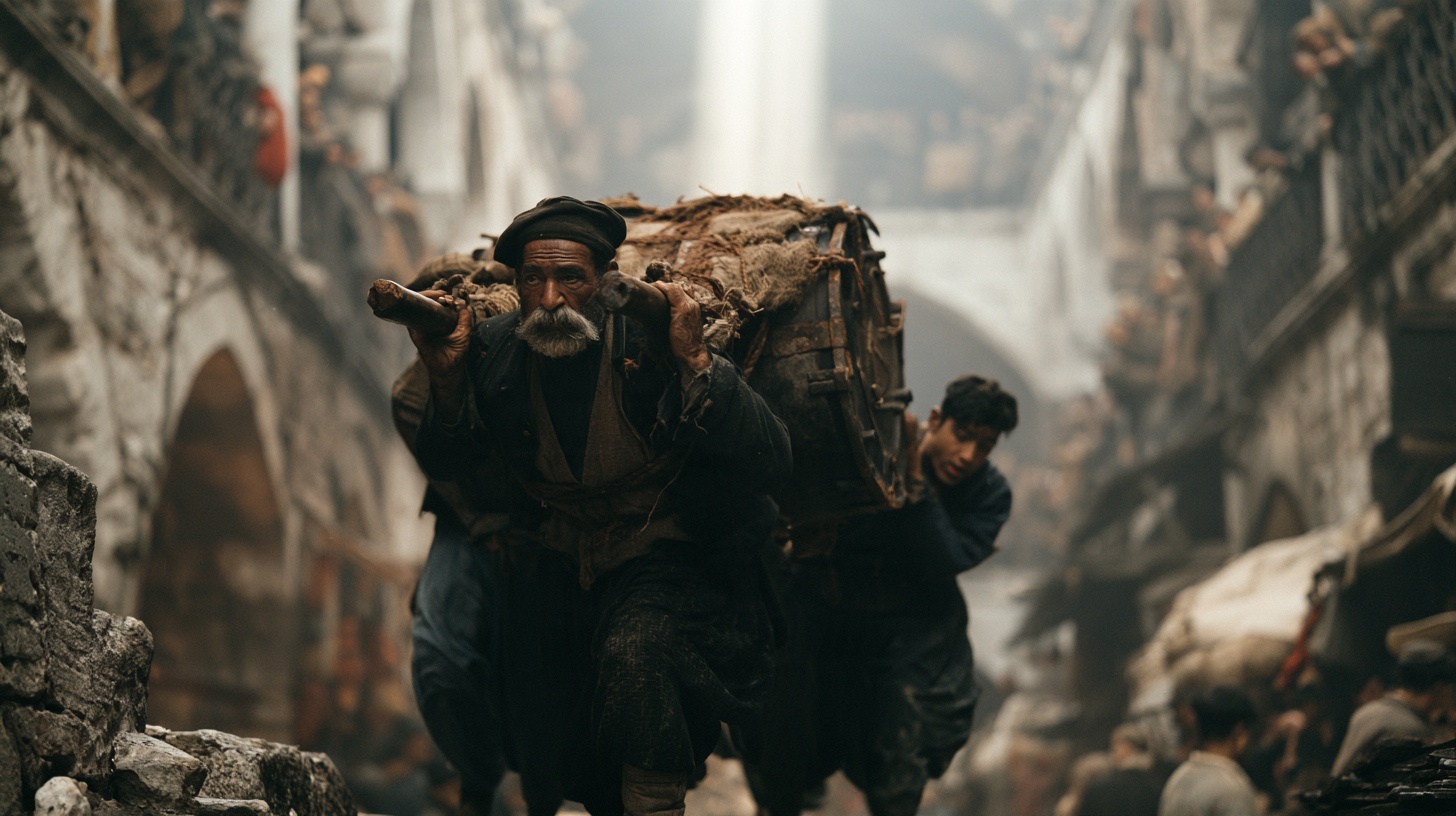
The word is destur, and it means make way, and for thirty-nine years it went ahead of Rüstem through the covered market like a bell before a cart. Under the mohair bales for the Harputlu brothers, destur. Under the copper for the tinners’ row, under the bolt cloth, under the Belgian mirrors that made him carry another man’s sweating face downstairs on his own back, destur, destur. The market parted and closed behind him and took no more notice than water takes of a ferry. That was the arrangement. A porter crosses every territory and holds none. He hears every price in the bazaar and owns nothing in it but his saddle. He knew which partnerships were dissolving by whose stock moved at night. He knew engagements before mothers did, from the weight of sent gold. None of it was his to sell, and none of it had ever gone with him past the gate, which is why every door in the bazaar stood open to a man who owned none of them.
The saddle was the semer, wood and wool, shaped to his spine by his spine, the way a stair hollows to feet. Merchants owned stock and shelf. The guild owned the stands, the corner rights, the order of the queue at the han gates. Rüstem owned the semer and what was under it, which was to say a back, which was to say a sum that had been spending itself since he was fourteen. He knew the arithmetic better than any of them. It was his trade to know what a thing weighed and what the stairs would take out of you for it. The Kasım Han ran four floors around its courtyard, no two steps cut the same, and he could tell you blind where the seventh stair on the north flight leaned, because his ankles kept the surveys his eyes were never asked for.
He was fifty-three. In the coffeehouse by the gate, where the guild’s tables stood by seniority, he sat two tables from the stove, which is as close as a man gets while still carrying.
The machine came to the Kasım Han in the autumn, in nine crates stenciled in a language nobody on the stairs could read. An elevator, for freight. The han’s new landlord had been to Vienna and come back with catalogues, and the merchants of the upper floors, who paid by the trip for every bale that reached them, had signed a letter saying the future could not be argued with. The shaft would go up the southeast corner where the broken stair had been closed since the fire. The crates sat in the courtyard under canvas, and the whole bazaar came by to look at them as you look at a strange animal that is going to live with you from now on.
The guild met the same week, in the coffeehouse, kâhya İdris presiding from the table nearest the stove. The position was simple and the vote was ninety to nothing. No porter of the guild would touch the crates. Let the landlord’s machine walk itself upstairs. The winding gear alone, said the freight papers, went past three hundred kilos, and the machine room sat at the top of the shaft, above the fourth gallery, because such a machine hauls from overhead, like a man pulling a bucket from a well. Whatever else was true of the future, it could not install itself. For once the stairs were on the guild’s side of the table.
Rüstem voted with the ninety. Then he went home, and lay on the floor, his bed these twenty years now that beds had gone soft on him, and did his accounts on the ceiling. Selim came into those accounts, as he came into most of them. Nineteen, his sister’s boy, four years on the stairs, quick, proud of the wrong things, already waking stiff on wet mornings. Already stiff, at nineteen. Rüstem had buried six men of the guild in his time, and the speeches at the graves said God gives and takes, and the speeches were wrong. He had watched what took them. It took them one stair at a time, starting at the knees, and it was patient, and it was on the rate card of every merchant in the han at so many kuruş the trip.
The landlord’s agent found him at the gate two mornings later, the way agents find the man a vote has made quiet. The offer was day wages. Rüstem named triple and the funeral money besides, because a man selling his good name ought at least to weigh it honestly, and when the agent laughed, Rüstem picked up his semer and had gone four steps before the laugh turned into terms. He took the money without shame and without ceremony. He has never once, in the years since, told the story as though his reasons made it clean.
He could not lift three hundred kilos alone, and no guild back would stand beside his now. He hired the Tahtacı brothers from the eastern gate, outsiders, wrong village, wrong accent, men the queue had kept at its tail for two years, and they said yes before he finished the sentence, because the queue’s tail is where principles get expensive. And he took Selim, who said yes for the worst reason there is, which is love.
İdris came to the courtyard the morning they uncrated the winding gear, and he did not lower his voice, and the galleries filled to listen the way they filled for a wedding or a beating.
You carry the guild’s grave up those stairs, Rüstem.
The stairs are the grave, Rüstem said, as loud, the one time in his life. I’ve carried six of us to Eyüp with my own shoulder under the board. The speeches said God took them. The stairs took them, İdris, at ten kuruş the trip, and every man at your table knows it in his knees, and the day this rope-wheel does the dying instead of Selim, I’ll have cheated the stairs of one boy, and you can have my table for it.
You’ll have no table, the kâhya said. No queue, no stand, no fund, no shoulder under your own board when it’s your turn. Write that into your price.
I did, Rüstem said. It’s in there.
The carry took one day, and the bazaar shut up to watch it, whatever it told itself it was doing instead. They went up with poles and rope and the old chants that set eight feet moving as four, destur rolling ahead of them up the north flight, the drum of the winding gear slung like a carcass between the poles, three hundred and forty kilos by the freight bill, the heaviest thing Rüstem had ever asked his body to witness. The turns at the landings were the killers, as the turns always are, the load swinging wide while four men make themselves into one hinge. Merchants stood in their doorways and did not offer water. A tinner’s apprentice did, ran out with a jug and held it to each mouth in turn while they stood braced at the landing, and was cuffed for it later, they heard, by his master, for serving traitors. The jug made the third floor possible. Somebody above the third gallery spat, and missed, and Rüstem noted the shadow of it pass the stone like a bird going over.
On the last turn but one, Selim’s foot found the seventh stair of the north flight, the leaning one, the one Rüstem’s ankles knew and his lesson had not yet reached, and the boy went sideways a hand’s width. The load surged. Rüstem took the surge the only place there was to take it, across his own base, and something low in his back made a small sound to him privately, like wet rope easing, not a tearing, just a letter of resignation, quietly handed in. He finished the flight. You do not put down three hundred and forty kilos on a staircase because of a letter. They set the drum on its bedplate above the shaft as the afternoon ezan came thin across the roofs, and the Tahtacı brothers laughed with their whole bodies, like men who have been paid and seen the sea on the same day, and Selim looked at his uncle and started to say the thing that was in his face, and Rüstem told him to coil the rope.
The machine ran before the first snow. A Viennese fitter in a necktie spent two weeks bolting and oiling, and then the landlord cut a ribbon, and the platform went up the shaft carrying twelve bales of mohair in under a minute, forty trips of stairs in the time it takes to drink a glass of tea, and the merchants of the upper floors applauded the arithmetic. The porters stood in the courtyard with their saddles on and watched the future go up without them, hating it correctly, because it was never going to be hungry and they were.
The guild kept the kâhya’s whole word. The envelope with Rüstem’s funeral money came to his room by a boy who would not step inside. His table at the coffeehouse had another man’s cup on it by Friday. In the queue at the other hans, where he still had two years of lighter loads left in him, the guild backs turned together when he passed, smooth as one animal, and he learned to take his tea standing at Niko’s, with the Tahtacı brothers, at the window with no stove near it. The wrong-village men had become his village. That is the price nobody writes on the bill, that you do not just lose your people, you are issued new ones, and they are kind, and they are not yours, and you drink your tea.
Selim the guild kept. That was the one mercy in it, and Rüstem had bargained for it as he had bargained for the triple, flatly, in the agent’s office, before a word of the rest: the boy was hired labor misled by an uncle, write it so. The guild chose to believe the paper because guilds also need their mercies. The boy sat now at the far end of the guild’s tables at nineteen, his back young and his name clean, and he did not greet his uncle in the courtyard, by agreement, by Rüstem’s own instruction, and obeying it was the only disobedience in him. He left a basket at the room door some weeks. Figs, once, out of season. The figs cost half a day’s winter wage. Rüstem ate them over three evenings. Neither of them ever said so out loud.
In the spring the landlord’s agent came to Niko’s window table with one more paper. The machine wanted a man. Gates to pull, loads to tally, floors to call. Forty years of stairs in the han had to be minded by somebody who knew what the building weighed, and the guild had declined, with dignity, to serve the enemy, and the enemy paid Fridays.
So the last porter of the Kasım Han rides his own defeat up the shaft eleven hours a day. No. Ten hours a day, gate to gate, standing, which his back can hold, carrying the whole bazaar and owning none of it, same as ever, the mohair and the copper and the Belgian mirrors rising behind the folding gate with his hand on the lever. He pulls the gate at each gallery and calls the floor to men who can see it perfectly well. And at the top, where the drum he carried turns in its oiled room, he says it still, every trip, to the empty landing, out of forty years of habit, under his breath, like a man greeting a grave he dug himself.
Destur. Make way.
♥ 2026 Claire Jacobs · CC BY 4.0 · a story from Good Day Mockingbird № 10