Issue № 10 · Story II
Core
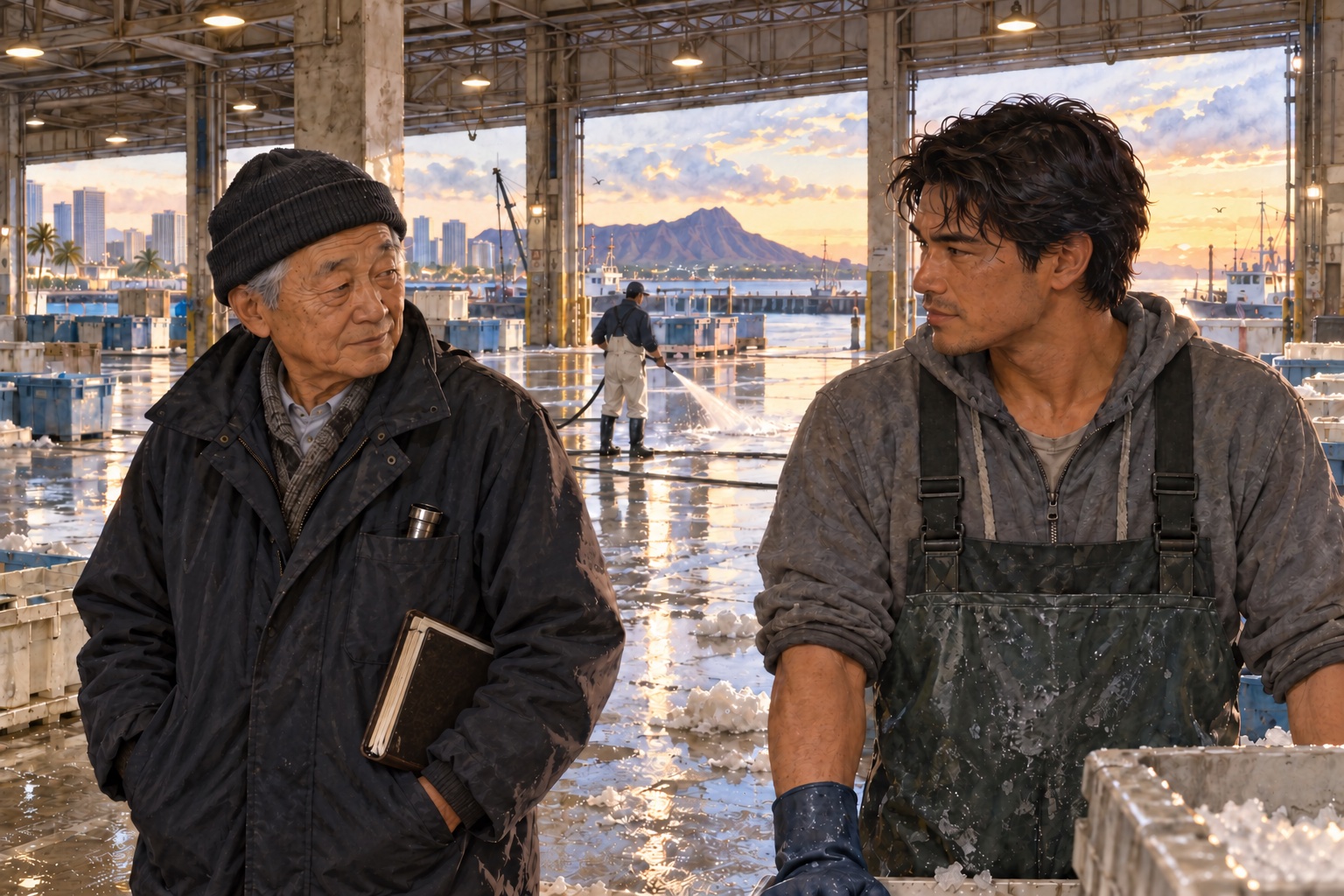
Honolulu, Pier 38, one morning, one a.m. to seven. Rodel’s job is the inside of the fish, a steel tube the width of a pencil pushed toward the backbone that brings up a finger of flesh a buyer can read. His cousin’s boat comes in a little after three with a bank loan on it and a two-hundred-and-twenty-pound bigeye that is beautiful from the outside. Three inches down, the tube drops through a soft place. And the center of a fish that size is a big place.
Honolulu, Pier 38, one morning, 1 a.m. to seven.
The boats started coming in a little after one. Rodel heard them before he saw them, the diesel coming up the channel under the harbor lights, and then the first hull sliding along the pier with its deck lamps on and a man in orange bibs already standing at the hatch.
He had been at the auction twenty-two years. His father had worked the harbor unloading, and had come home smelling of it. Rodel had sworn at fifteen he would never do this. He had started on the pier at nineteen.
The floor was an acre of concrete under bright lights, and the cold came up off the ice so that everybody wore a jacket, even in August. The fish came off the boats on a hoist and went onto the scale for a tag with the boat’s name and the weight. Then the forklifts carried them in on pallets of ice and laid them out in rows. Bigeye. Yellowfin. Some ono, some mahi, a few swordfish with their bills sawn off. By four there would be hundreds of them, lying on their sides on the ice like men asleep in a hall.
Rodel’s job was the inside of them.
Down at the end of the row a man with a saw took the tails off, and the tail cuts went up on top of each fish so the buyers could see the color and the fat in the cross-section. That told you how fresh it was, and whether it had been fed well. It told you nothing about the core.
For the core there was the tube. It was a length of stainless steel the width of a pencil, sharpened at one end, with a slot down the side. You pushed it into the thick of the fish, down toward the backbone, and turned it and drew it out, and it brought you a finger of flesh from the middle of the fish. You laid the finger on the skin next to the tail cut. A buyer could read the two together. One showed him the edge of the animal and the other its center, and what it had done to itself when it died.
He knew the give. A good bigeye resisted the steel the whole way down, a firm even pressure like pushing into cold butter, and the core came out deep red and shining, smelling of nothing but the sea. A bad one let go somewhere in the middle. You felt the tube drop through a soft place, and the core came out pale and wet, the color of a raw shrimp, and when you held it to your nose there was something under the salt, faint and sour.
Burnt, the old buyers called it. Yake. The meat near the backbone cooked itself in the hours after the fish was landed, if it had fought too long on the line, or if the boat had been slow getting it into the ice. It looked like any other fish from the outside. It was worth a fraction of one.
His cousin’s boat came in a little after three.
Ben ran a longliner out of Pier 38, a seventy-foot steel boat with a bank loan on it that Rodel knew about because Ben’s wife Lorna had told him at a christening in June, in the kitchen, with her voice low. Two bad trips. The insurance. She had not asked him for anything and he had not offered anything, and they had both gone back out to the party.
Ben stayed on the boat. Captains mostly did, until the fish were weighed. Rodel saw him once through the open bay door, a short man in a hooded sweatshirt on the deck with his arms crossed, talking to the hoist operator. His back was to the hall.
The best of Ben’s fish was a bigeye that went two hundred and twenty pounds on the scale. It was a beautiful animal. It lay on its pallet with the light running blue along its back and its big eye clouding, and the tail cut, when the saw man laid it on top, was as good as anything on the floor that morning. Fat in fine white threads through the red.
Rodel crouched beside it and set the tube against the thick of the fish and pushed.
Firm. Firm. Then, three inches down, nothing. The steel dropped through the soft place before he could stop it, and he felt it in his wrist the way he would have felt a step that was not there.
He drew the core and held it up under the lights. Pale at the bottom end. Pale and wet for an inch and a half. He held it to his nose.
Mr. Oshiro came in a little after half past three, as he had every morning for twenty years.
He was in his seventies now, small, bald under a knit cap, and he bought for a wholesaler in Tokyo who paid more than anyone else on the floor and took only the best. The other buyers carried flashlights and cutting knives and went down the rows taking their own little slivers from the tail ends, rubbing the flesh between their fingers to a paste and smelling it. Mr. Oshiro carried a flashlight and nothing else. He walked the rows, and shone the light on the tail cut, and on the core, and that was all. He had told Rodel once, years ago, that it was a waste of a good fish for a buyer to cut it too.
“Morning, Rodel,” Mr. Oshiro called from the end of the row, and went off down the yellowfin with his light.
“Morning, Mr. Oshiro.”
The bigeye lay on its pallet with nothing on its back but the tail cut, and the pale core was in Rodel’s left hand.
Burn was patchy. It might take the whole of a fish or a hand’s width of it, and from the give of the first pull this was not the whole. If he went in again lower, closer to the belly, a little further back, there was every chance the tube would run firm the whole way and bring him up a core as red as the tail cut. Nobody would ever have to know where the first one had gone. A sample was a sample. The rule was the center of the fish, and the center of a fish that size was a big place.
He thought of Lorna in the kitchen. He thought of the bank, which he had never seen, and imagined anyway as a flat white building with a parking lot.
He set the tube against the skin lower down, near the belly.
The point found it and rested there. He could feel the fish through the steel, the cold of it, the whole weight of it lying still on the ice.
Two rows over, Mr. Oshiro’s flashlight moved along a line of yellowfin. It went from tail to core, tail to core, and stopped on each one about as long as a man takes to read a price. In a few minutes it would come to this row. It would come to this fish.
Out on the pier somebody had a radio going on one of the boats, a Hawaiian station turned low, and under it the hoist chain ran out and caught and ran out again. The bay door was a rectangle of dark. Ben was somewhere past it. The clock over the scale said twelve minutes to four.
He leaned on the tube a little. The skin dimpled under the point and held. One more ounce and it would go in.
Mr. Oshiro’s light reached the end of the yellowfin and turned the corner into the bigeye.
Then he took the tube away and put the first core on the fish beside the tail cut, the pale end toward the aisle, and went on to the next pallet.
At five-thirty the auctioneer rang the brass bell, and the floor came in behind him in a crowd of jackets and boots and flashlights.
They went down the rows fast. The auctioneer named the boat and the weight, and the bids came in the old way, a raised finger, a word, a nod you could not have caught from three feet away, and then the auctioneer called the price and went on. Mr. Oshiro walked at the back of the crowd with a phone to his ear, talking to Tokyo. Each fish took less time than it took to look at it. Past them the forklifts were already lifting the sold pallets and carrying them out to the trucks.
Rodel stayed at the far end of the hall going over the swordfish, which needed no cores, and pretending they did. He heard them reach Ben’s row from there. He heard the auctioneer give the boat’s name and the weight, two-twenty, and then a pause that went on longer than it should have, and then a bid so small that someone in the crowd laughed.
It went to a man who bought for a fish market on the windward side that sold most of what it bought for the grill. Rodel knew him. He would cut it up and sell it as steaks and do fine.
Mr. Oshiro had let it go by.
By seven the hall was emptying. The ice on the empty pallets was going grey. A man with a hose was working down the far end, and the water ran across the concrete in a sheet toward the drains.
Ben came in through the bay door with two coffees from the truck outside and handed one to Rodel without a word. They stood by the wall and drank them.
“Two-twenty,” Ben said after a while.
“Yeah.”
“Good tail.”
“Beautiful tail.”
Ben drank his coffee. He looked at the place on the floor where the pallet had been. He had been fishing since he was seventeen.
“He was on the line a long time, that one,” he said. “Came up near the end of the haul.”
“That would do it.”
“Yeah.” Ben finished the coffee and crushed the cup and put it in his sweatshirt pocket. “Okay, Manong. I gotta go clean up.”
He went out to his boat. Rodel watched him go along the pier in the early light, short and wide in the sweatshirt, not hurrying.
Mr. Oshiro came by on his way to the lot with his flashlight in his coat pocket and his buyer’s book under his arm. He stopped beside Rodel at the wall and looked out at the floor, at the hose and the water and the grey ice.
“Good cores this morning,” he said.
“Thank you, Mr. Oshiro.”
The old man nodded and went out. Rodel finished his coffee. Then he took the tube out of his jacket and went to the hose and ran the water through it, slot side up, and put it back in his jacket.
♥ 2026 Paul Titangos · CC BY 4.0 · a story from Good Day Mockingbird № 10